


Introduction
Technology has become a central part of everyday life. From managing schedules and tracking fitness goals to handling finances and staying connected with friends, mobile and desktop applications help people complete countless tasks efficiently. However, with millions of apps available across various platforms, finding the perfect one can feel overwhelming. This is where understanding how to choose the right app for your daily needs becomes extremely important.
Many users download applications based on popularity alone, only to discover later that the app does not match their requirements. Some apps offer impressive features but are difficult to use, while others may have excellent usability but lack essential functions. Making the wrong choice can lead to wasted time, reduced productivity, and unnecessary frustration.
Choosing the right app is not simply about downloading the most popular option. Instead, it involves evaluating features, usability, security, compatibility, pricing, and long-term value. Whether you are looking for a productivity tool, note-taking application, budgeting solution, fitness tracker, or communication platform, selecting the right app can significantly improve your daily routine.
This comprehensive guide explains how to choose the right app for your daily needs, explores important evaluation criteria, and provides practical recommendations for beginners and intermediate users. By following these strategies, you can confidently identify applications that genuinely support your lifestyle, goals, and preferences.
What is How to Choose the Right App for Your Daily Needs?
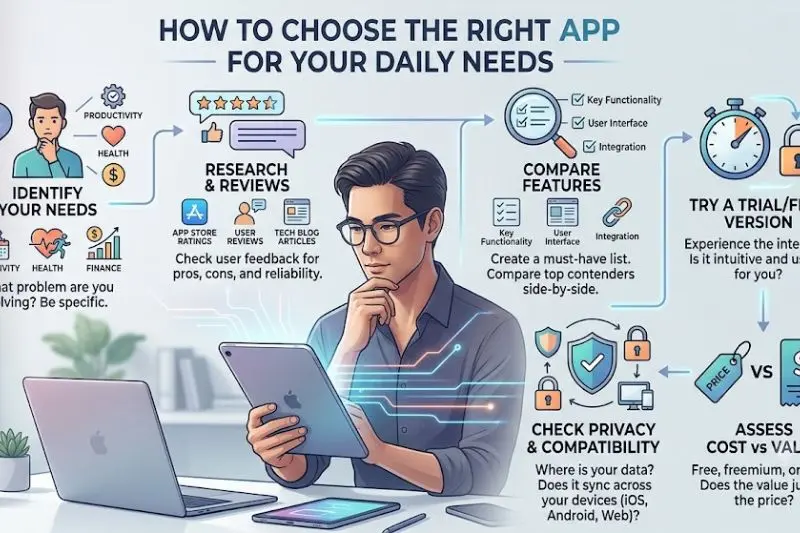
The concept of how to choose the right app for your daily needs refers to the process of identifying, evaluating, and selecting software applications that effectively support your personal or professional activities.
Rather than installing apps randomly, users assess factors such as:
- Purpose
- Features
- Ease of use
- Cost
- Security
- Compatibility
- User reviews
- Performance
The goal is to find an application that solves a specific problem while providing a positive user experience.
For example:
- A student may need a note-taking app.
- A professional may need project management software.
- A fitness enthusiast may need a workout tracker.
- A small business owner may need accounting software.
The ideal app depends entirely on individual requirements.
Why is How to Choose the Right App for Your Daily Needs Important?

Selecting the right application affects productivity, convenience, and overall digital experience.
Saves Time
The right app streamlines tasks and reduces unnecessary effort.
Improves Productivity
Efficient tools help users accomplish more in less time.
Reduces Frustration
Well-designed apps provide smoother experiences and fewer obstacles.
Enhances Organization
Proper apps help users manage information effectively.
Protects Data
Reliable applications often offer better privacy and security protections.
Prevents Wasted Spending
Choosing carefully helps avoid subscriptions for software that provides little value.
Supports Long-Term Goals
The right tools can contribute significantly to personal and professional growth.
Detailed Step-by-Step Guide
Step 1: Identify Your Purpose
Before downloading any app, define exactly what you need it to accomplish.
Ask yourself:
- What problem am I trying to solve?
- What tasks will I perform regularly?
- Do I need personal or professional functionality?
- Will I use the app daily?
Having clear objectives simplifies decision-making.
Step 2: List Essential Features
Not all features are equally important.
Create two lists:
Must-Have Features
Examples:
- Offline access
- Cloud synchronization
- File sharing
- Data backup
Nice-to-Have Features
Examples:
- Themes
- Advanced customization
- Integrations
- Widgets
This approach prevents distraction from unnecessary functions.
Step 3: Research Available Options
Research multiple applications before making a choice.
Consider:
- Popular apps
- New alternatives
- Specialized solutions
- Industry recommendations
Comparing options provides a broader perspective.
Step 4: Evaluate User Reviews
User reviews often reveal valuable insights.
Look for information about:
- Stability
- Ease of use
- Customer support
- Updates
- Reliability
Pay attention to recurring complaints and positive experiences.
Step 5: Check Compatibility
Compatibility is a critical factor when learning how to choose the right app for your daily needs.
Ensure the app works on:
- Smartphones
- Tablets
- Laptops
- Desktop computers
Cross-platform support improves flexibility.
Step 6: Assess User Interface and Experience
An app may offer excellent features but still be difficult to use.
Evaluate:
- Navigation
- Design
- Accessibility
- Learning curve
Simple and intuitive interfaces often provide better long-term value.
Step 7: Compare Pricing Models
Apps typically follow one of several pricing structures.
Free Apps
Benefits:
- No upfront cost
- Easy to try
Limitations:
- Advertisements
- Feature restrictions
Subscription Apps
Benefits:
- Continuous updates
- Premium support
Limitations:
- Recurring costs
One-Time Purchase Apps
Benefits:
- Permanent ownership
Limitations:
- Less frequent updates
Choose the model that aligns with your budget and usage patterns.
Step 8: Review Security Features
Security should never be overlooked.
Important considerations include:
- Encryption
- Secure login methods
- Data protection policies
- Privacy settings
Applications handling sensitive information require extra scrutiny.
Step 9: Test Before Committing
Whenever possible, use free trials.
Testing allows you to evaluate:
- Performance
- Usability
- Features
- Reliability
Hands-on experience often reveals strengths and weaknesses.
Step 10: Consider Scalability
Your needs may evolve over time.
Choose apps that can grow with you.
Examples include:
- Additional storage options
- Advanced features
- Team collaboration capabilities
Scalable solutions often provide better long-term value.
Step 11: Evaluate Customer Support
Reliable support becomes important when issues arise.
Look for:
- Knowledge bases
- Email support
- Live chat
- Community forums
Strong support improves overall satisfaction.
Step 12: Make the Final Decision
After comparing all factors, select the app that best balances:
- Features
- Cost
- Usability
- Security
- Performance
Remember that the perfect app is the one that effectively meets your needs.
Benefits of How to Choose the Right App for Your Daily Needs
Following a structured app selection process provides many advantages.
- Better productivity
- Improved efficiency
- Enhanced organization
- Reduced frustration
- Better user experience
- Stronger security
- More effective workflows
- Cost savings
- Improved time management
- Greater flexibility
- Easier collaboration
- Better data management
- Reduced digital clutter
- Increased satisfaction
- Long-term value
These benefits help users maximize technology’s potential.
Disadvantages / Risks
Despite the advantages, there are some challenges involved.
- Research requires time
- Too many options may cause confusion
- Reviews can sometimes be misleading
- Popular apps may not fit individual needs
- Premium features may increase costs
- Frequent updates can change functionality
- Privacy concerns with some applications
- Learning curves for advanced tools
- Subscription fatigue
- Potential compatibility issues
Awareness of these risks helps users make smarter decisions.
Common Mistakes to Avoid
Many people make avoidable errors when selecting applications.
Choosing Based Only on Popularity
Popularity does not guarantee suitability.
Focus on your own needs.
Ignoring Reviews
User feedback often reveals issues not visible in marketing materials.
Overlooking Security
Security should always be a priority.
Especially for apps handling personal information.
Installing Too Many Apps
Too many similar applications create clutter and confusion.
Focusing Only on Price
Free apps are not always the best choice.
Value matters more than cost alone.
Ignoring Future Needs
Choose apps that can adapt as your requirements grow.
Skipping Free Trials
Testing software before purchasing reduces risk.
Not Checking Device Compatibility
Compatibility problems can limit usability.
Always verify system requirements.
FAQs
1. Why is choosing the right app important?
The right app improves productivity, organization, and efficiency while reducing frustration and wasted time.
2. How can I determine whether an app meets my needs?
Start by identifying your goals and comparing available features with your requirements. Testing free versions can also help.
3. Are paid apps always better than free apps?
No. Many free apps provide excellent functionality. Paid apps often offer advanced features, support, and fewer limitations.
4. How many apps should I use for the same purpose?
Generally, one well-chosen app is sufficient. Multiple apps with overlapping functions can create confusion.
5. What role do user reviews play?
Reviews provide real-world insights into performance, usability, reliability, and customer support.
6. Should security influence app selection?
Absolutely. Security is critical, especially for apps that store personal, financial, or business information.
7. How often should I review my app choices?
Review your apps periodically to ensure they still meet your needs and remain competitive with newer alternatives.
8. What is the best way to compare apps?
Create a checklist including features, pricing, usability, compatibility, and security. Compare each option systematically.
Expert Tips & Bonus Points
To master how to choose the right app for your daily needs, consider these professional recommendations.
Define Clear Objectives
Know exactly what you want the app to accomplish.
Prioritize Simplicity
Simple apps often deliver better long-term experiences.
Read Both Positive and Negative Reviews
Balanced research provides a clearer picture.
Focus on Value
Choose software that provides meaningful benefits rather than unnecessary features.
Avoid Feature Overload
Complexity can reduce productivity.
Check Update History
Frequently updated apps often demonstrate active development.
Protect Your Privacy
Review permissions carefully before installation.
Test Multiple Options
Comparing two or three alternatives helps identify the strongest solution.
Consider Long-Term Costs
Evaluate subscription expenses over time.
Build a Personal App Ecosystem
Choose apps that integrate well with your existing tools.
Conclusion
Understanding how to choose the right app for your daily needs is an essential skill in today’s technology-driven world. With thousands of applications competing for attention, making informed decisions helps users avoid unnecessary downloads, reduce frustration, and improve overall productivity.
The best app is not always the most popular or expensive option. Instead, it is the application that aligns closely with your goals, preferences, budget, and workflow. By identifying your requirements, researching available options, evaluating security, testing usability, and considering long-term value, you can confidently select tools that genuinely support your daily activities.
Whether you need a productivity app, budgeting tool, communication platform, fitness tracker, or note-taking solution, following a structured evaluation process increases the likelihood of success. Taking time to compare features and assess user experiences may require some effort initially, but it often leads to better outcomes in the long run.
As technology continues to evolve, new applications will emerge regularly. Developing strong app selection habits ensures that you remain adaptable and capable of choosing tools that enhance both personal and professional life. By applying the strategies outlined in this guide, you can make smarter decisions and build a digital environment that supports efficiency, organization, and long-term success.
