


Introduction
Kimi K3 has quickly become one of the most searched AI-related topics in the UK over the past week. As a breakout Google Trends topic, it has attracted attention from developers, businesses, researchers, and everyday AI enthusiasts who are eager to understand what makes this new model different from existing large language models.
The rapid evolution of artificial intelligence has led to increasingly powerful models capable of reasoning, coding, writing, research, and multimodal understanding. Every major AI release creates significant discussion, and Kimi K3 is no exception. Its growing popularity reflects increasing interest in faster, smarter, and more cost-effective AI assistants.
Whether you’re a beginner curious about the latest AI technology or an experienced developer looking for the next generation of language models, understanding Kimi K3 is essential. Many users are comparing it with popular AI systems while exploring its strengths, limitations, and practical applications.
This comprehensive guide explains everything currently known about Kimi K3, including its latest developments, reasons for its sudden popularity, key features, benefits, drawbacks, frequently asked questions, and expert insights. The information presented here focuses on verified facts and avoids speculation where official details remain limited.
What is Kimi K3?
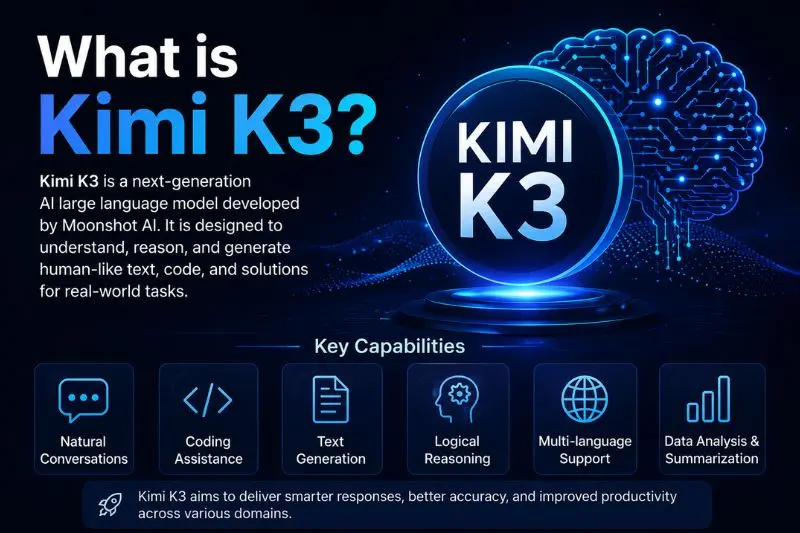
Kimi K3 is a new-generation artificial intelligence large language model developed by Moonshot AI, a Chinese AI company known for its Kimi AI assistant.
The model is designed to understand natural language, generate high-quality text, solve programming problems, assist with research, summarize documents, and perform complex reasoning tasks.
Like other modern AI models, Kimi K3 aims to improve:
- Natural conversation
- Coding assistance
- Mathematical reasoning
- Knowledge retrieval
- Content generation
- Business productivity
- Multilingual communication
Although official technical documentation is still evolving, Kimi K3 represents another significant step in the rapidly growing AI ecosystem.
Quick Overview
| Feature | Details |
|---|---|
| Name | Kimi K3 |
| Developer | Moonshot AI |
| Category | Large Language Model (LLM) |
| Industry | Artificial Intelligence |
| Primary Use | AI Assistant & Content Generation |
| Trending Region | United Kingdom |
| Google Trends Status | Breakout |
Latest Updates / Release Information
Kimi K3 has recently gained significant online attention following announcements and discussions within the AI community.
Recent highlights include:
- Improved reasoning capabilities
- Better coding performance
- Faster response generation
- Enhanced multilingual understanding
- More efficient model architecture
- Strong benchmark discussions across AI communities
Since the topic is still developing, some benchmark claims continue to be evaluated by independent researchers. Readers should rely on official technical publications as additional information becomes available.
Why is Kimi K3 Trending?
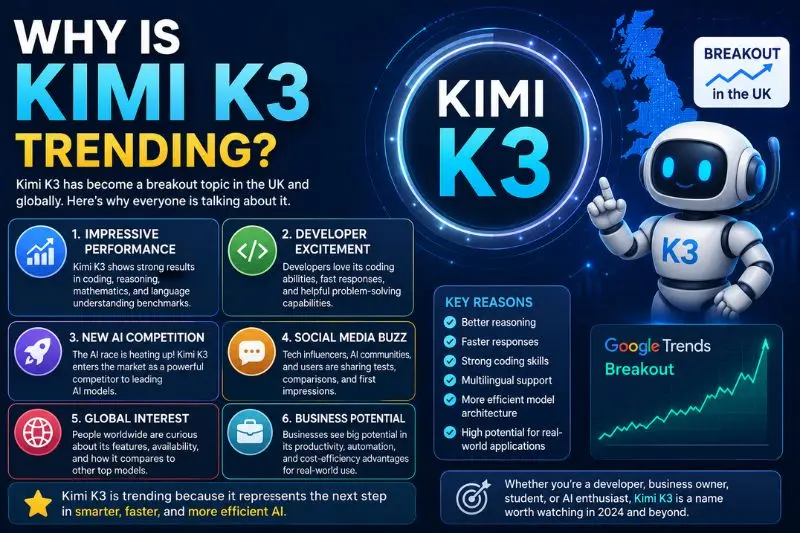
Several factors have contributed to the sudden increase in searches.
1. New AI Competition
The AI industry is evolving rapidly, with companies introducing increasingly capable language models.
2. Performance Benchmarks
Technology enthusiasts are interested in benchmark comparisons involving reasoning, coding, mathematics, and language understanding.
3. Developer Interest
Developers want alternatives that provide:
- Better API performance
- Lower operational costs
- Faster inference
- Strong coding assistance
4. Social Media Discussions
Technology influencers and AI researchers have been discussing Kimi K3 across multiple platforms, increasing public awareness.
5. Business Adoption
Organizations continue searching for AI models that balance capability, affordability, and scalability.
Detailed Guide
Overview
Kimi K3 belongs to the latest generation of transformer-based language models capable of understanding natural language prompts and generating contextual responses.
Its intended use cases include:
- Customer support
- AI chatbots
- Programming assistance
- Research
- Education
- Business automation
- Marketing
- Content writing
Key Features
- Advanced natural language understanding
- Improved reasoning
- Context-aware responses
- Coding assistance
- Mathematical problem solving
- Long-form writing
- Summarization
- Translation
- Brainstorming
- Business productivity
Typical Use Cases
Content Creation
- Blog writing
- Marketing copy
- SEO content
- Product descriptions
Programming
- Code generation
- Bug fixing
- Documentation
- Code explanation
Business
- Email drafting
- Reports
- Meeting summaries
- Customer support
Education
- Homework assistance
- Concept explanations
- Research summaries
- Language learning
Benefits of Kimi K3
Users may benefit from Kimi K3 in several ways.
Improved Productivity
Many repetitive writing and research tasks can be completed faster.
Better Coding Assistance
Developers can receive code suggestions, debugging help, and explanations.
Faster Information Processing
Large amounts of text can be summarized into concise insights.
Multilingual Support
International users may benefit from broader language capabilities.
AI-Powered Creativity
Useful for:
- Brainstorming
- Story writing
- Marketing campaigns
- Content ideas
Risks or Disadvantages
Despite its strengths, Kimi K3 also has limitations.
Limited Official Information
Some technical specifications remain undisclosed.
Hallucinations
Like other language models, incorrect or fabricated answers remain possible.
Privacy Concerns
Users should avoid submitting confidential or sensitive information unless they fully understand the platform’s privacy policies.
Benchmark Limitations
Benchmark scores do not always reflect real-world performance.
Rapid AI Competition
New AI releases can quickly change comparative rankings.
Common Myths, Fan Theories & Mistakes
Myth 1: Kimi K3 is identical to every AI chatbot.
Reality: Each AI model differs in training, architecture, optimization, and capabilities.
Myth 2: It always provides correct answers.
Reality: AI models can still make factual mistakes.
Myth 3: Bigger automatically means better.
Reality: Model quality depends on training, optimization, reasoning, and evaluation—not just size.
Common User Mistakes
- Blindly trusting every answer
- Not fact-checking important information
- Using vague prompts
- Ignoring privacy considerations
Hidden Details & Bonus Information
Interesting facts about Kimi K3 include:
- It has increased competition within the global AI landscape.
- Businesses are monitoring new AI releases to diversify their AI tools.
- Developers are particularly interested in coding performance.
- AI benchmarking remains an evolving field, with real-world testing often more informative than synthetic scores.
- The growing popularity of open and commercial AI ecosystems is encouraging faster innovation.
Frequently Asked Questions
What is Kimi K3?
Kimi K3 is a large language model developed by Moonshot AI, designed to assist with writing, coding, reasoning, research, and conversational AI tasks.
Why is Kimi K3 trending in the UK?
It became a Google Trends breakout topic due to growing discussions about its AI capabilities, benchmark performance, and competition with other advanced language models.
Who developed Kimi K3?
Kimi K3 was developed by Moonshot AI, the company behind the Kimi AI assistant.
Can Kimi K3 generate code?
Yes. One of its intended strengths is helping developers write, explain, and debug code.
Is Kimi K3 free?
Availability depends on the platform and deployment. Some features may be free while advanced access could require subscription or API usage.
Is Kimi K3 better than other AI models?
There is no universal “best” AI model. Performance depends on the specific task, and independent evaluations continue as more testing becomes available.
Expert Tips & Bonus Secrets
To get the most from Kimi K3:
- Write detailed prompts instead of short questions.
- Break complex tasks into smaller steps.
- Verify important facts using reliable sources.
- Request revisions if the first response isn’t ideal.
- Use structured prompts for coding and research tasks.
- Compare AI outputs when accuracy is critical.
- Avoid sharing confidential information.
- Experiment with role-based prompting for more specialized responses.
Conclusion
Kimi K3 has rapidly emerged as one of the most talked-about AI models, explaining why it became a breakout Google Trends topic in the UK. Interest in the model reflects the intense competition within the artificial intelligence industry, where new language models are continually pushing the boundaries of reasoning, coding, multilingual communication, and productivity.
While official technical information continues to evolve, Kimi K3 already represents another important milestone in the expansion of advanced AI assistants. Its focus on natural language understanding, software development support, document processing, and business productivity makes it relevant for a wide range of users, from students and professionals to developers and content creators.
As with any AI technology, users should approach outputs thoughtfully by verifying important facts and using the model responsibly. Real-world performance often depends on prompt quality, intended use case, and ongoing model improvements.
If development continues at its current pace, Kimi K3 is likely to remain an important name in AI discussions throughout 2026. Keeping up with official updates and independent evaluations will help users make informed decisions about where this model fits within the rapidly changing AI landscape.
